Living, Working, and Wasting Time in Southern Manitoba

Category: Federal (Page 2 of 2)

Failing grade for Conservative MP


F

As a former school teacher, I expect more from Joy Smith, M.P., so I’m giving her an “F” on her latest self imposed assignment, a letter to Amnesty International (AI) on their recently leaked proposed policy document on legalized prostitution.

It is obvious to me that she didn’t read the document, or that she has very poor reading comprehension skills, as her letter posted on the Huffington Post website completely misrepresents what Amnesty International is (allegedly) trying to say.

I have to give her credit though. If not for her opposition to it, I would have never read Amnesty’s policy document, which is a well thought out and researched statement. It balances the rights of consenting adults to participate in activities that involve nobody else while still advocating that the state has a place to make sure that everyone involved is doing so of their own free will, without “coercion, threats, or violence”.

In Smith’s first sentence she goes off the rails, “I am writing to urge Amnesty International to reconsider its policy position, leaked to the public, which promotes the legalization of prostitution and the rights of pimps over the rights of victims of sexual exploitation.” The emphasis is mine, but it shows that she has not read the document. The entire point of AI’s position is to advocate for those who willingly choose sex work. They do not once advocate for pimps. The closest I can see is where they touch on laws like Canada’s “living on the avails” recently struck down by the Supreme Court.

The blanket criminalization of the clients of sex work, or of support functions such as
body guards and receptionists, has also proven to drive those engaged in sex work
underground, increasing the risk of violence and abuse. Where aspects of sex work
remain criminal, those engaging in sex work are less inclined to seek both routine care
and urgent protection. Moreover, the criminalization of “living off the proceeds of
prostitution,” while perhaps intended to cover those who exploit sex workers, has
been shown to apply to both help-functions (guards, receptionists, landlords), as well
as roommates, family, and even children.

This section is obviously aimed at the sex worker’s ability to procure safer work conditions for herself and the legal ramifications for those that may share any accommodation with her. It is not meant to be a defense of the coercion, threats, and violence of pimps, the entire document in fact seems to be about getting rid of the conditions that would enable pimps to flourish.

Ms. Smith goes on further to claim that AI’s position on individuals with disabilities is “highly offensive and degrading”” to the disabled community”. Here is the alleged offensive section.

Along similar lines, men and women who buy sex from consenting adults are also
exercising personal autonomy. For some—in particular persons with mobility or
sensory disabilities or those with psycho-social disabilities that hamper social
interactions—sex workers are persons with whom they feel safe enough to have a
physical relationship or to express their sexuality. Some develop a stronger sense of
self in their relationships with sex workers, improving their life enjoyment and
dignity. At a very basic level, expressions of sexuality and sex are a primary
component of the human experience, which is directly linked to individuals’ physical
and mental health. The state’s interference with an adult’s strategy to have sex with
another consenting adult is, therefore, a deliberate interference with those individuals’
autonomy and health.

Apparently Ms. Smith cannot face the reality that some disabled people, while having very real sexual needs, may not be able to find someone through typical avenues that may be able to help them fulfill those needs. It is a fact that in our society sex is not always an equal opportunity experience, and that some individuals may not have the same access to fulfilling their own natural sexual needs. Who am I to deny someone the fulfilling of their reasonable sexual desires with another consenting adult, just because that act may require an exchange of currency or other favours. It is in fact Ms. Smith who is highly offensive and degrading to those with disabilities as she somehow thinks that she is in the position to make their personal sexual choices for them.

Joy, it is none of your damn business.

As for her contention that Amnesty is abandoning victims, she again goes off on a tangent. She starts talking about under-age victims of the sex-trade. Repeatedly Amnesty International states that their policy is about consenting adults.

Amnesty International considers children involved in commercial sex acts to be
victims of sexual exploitation, entitled to support, reparations, and remedies, in line
with international human rights law. States must take all appropriate measures to
prevent violence and exploitation of children. The best interests of the child should, in
all cases, be a primary consideration and the state should preserve the right of the
child to be heard and to have his or her views given due weight in accordance with
their age and maturity.

They repeat this position multiple times throughout the document. Amnesty International is against the exploitation of children, there is no doubt about this. Ms. Smith’s blatant dishonesty about this fact is disappointing.

Even in her closing argument, Smith refers to a study that shows correlation between legalizing sex work and human trafficking. Even the authors of said study state in their conclusion the following:

However, such a line of argumentation overlooks potential benefits that the legalization of prostitution might have on those employed in the industry. Working conditions could be substantially improved for prostitutes—at least those legally employed—if prostitution is legalized. Prohibiting prostitution also raises tricky “freedom of choice” issues concerning both the potential suppliers and clients of prostitution services. A full evaluation of the costs and benefits, as well as of the broader merits of prohibiting prostitution, is beyond the scope of the present article.

I do not have any problem with the fact that Ms. Smith has an opinion that is opposed to legalizing prostitution in Canada, she has the right to an opinion. My problem is with the fact that she misrepresents the position of those who disagree with her. As she is a former science teacher, her inability to grasp the statements and facts in relation to this topic flabbergasts me. She has been given the tools to interpret what she is reading, yet fails to.

Fine, she doesn’t like prostitution, but that doesn’t mean that it should be illegal. Yes, we should have controls on sex work so that it can be practiced safely and legitimately in Canada, and Amnesty International said as much.

It is obvious that the Conservative Government of Joy Smith and Peter MacKay is about to foist on us a new prostitution law based on the “Nordic Model”, which aims to protect sex workers by criminalizing their customers. It does not take a brain surgeon to realize the inherent problem with this plan. Because the customers are criminalized, the sex worker must then go to the places where the customers are. This puts her right back in the dangerous conditions that the Amnesty document and the Supreme Court of Canada decision were trying to rectify. Any rational person will see after some thought that such an approach will end up back at the SCoC where it will again be struck down. The Court’s decision made it clear, at least to me, that reasonable laws that respected the sex worker’s right to ply his or her trade would be acceptable, but that those which put unreasonable limitations on their ability to earn a living would be struck down. This is not very difficult to understand.

Perhaps Amnesty’s opening paragraph puts it best:

Amnesty International is opposed to the criminalization or punishment of activities
related to the buying or selling of consensual sex between adults. Amnesty
International believes that seeking, buying, selling and soliciting paid sex are acts
protected from state interference as long as there is no coercion, threats or violence
associated with those acts. Legitimate restrictions may be imposed on the practice of
sex work if they comply with international human rights law (i.e., they are for a
legitimate purpose, appropriate to meet that purpose, proportionate and nondiscriminatory).

…We believe that a policy based on human right principles that values
the input and experiences of sex workers is the most likely to ensure that no one
enters or stays in sex work involuntary.

If Peter MacKay and Joy Smith could craft a law that would meet that statement, we would have something that would stand up to the Charter, therefore surviving legal challenge, and would respect the rights of all Canadians.

Peter MacKay’s potentially wasted opportunity

Sometimes you just see something coming. You see the potential for the best possible outcome, but somehow you know that the worst or something close to it is on its way.

This is the case with the current situation on Canada’s prostitution laws. Peter MacKay needs to draft new prostitution laws by next December, and it appears that he is just going to make it worse. This is all of a sudden an issue because the Supreme Court of Canada struck down large parts of Canada’s current prostitution laws back on December 20, 2013.

The three parts of the law struck down were:

  1. Keeping a Common Bawdy-House
  2. Living on the Avails of Prostitution
  3. Communicating in a Public Place

Now, I’m no lawyer, and I will admit that the over 80 page decision was not closely read by me. However, I do understand that the crux of the SCoC’s ruling was that the three struck down areas were struck because they interfered with the “security of the person” guarantees of the Charter.

“The prohibitions at issue do not merely impose conditions on how prostitutes operate.  They go a critical step further, by imposing dangerous conditions on prostitution; they prevent people engaged in a risky — but legal — activity from taking steps to protect themselves from the risks.”

It really isn’t that difficult of a concept. The Court basically said this: prostitution is not illegal in Canada, therefore passing laws that make it impossible to practice a legal profession fall outside the accepted provisions of the Charter of Rights and Freedoms. The Court deferred its decision for a year to allow Parliament to pass new laws to regulate prostitution. It was pretty obvious to me that by “regulate” the Court meant things such as where and when prostitution could be practiced. Passing an outright ban of any kind is obviously something that would go against the spirit of the decision made public on December 20.

So, where is MacKay on all of this? He has mused the last few days that the government is not looking at provisions against prostitutes; they will now concentrate on laws that target johns and pimps.
Targeting pimps I have no problem with. These reprehensible individuals are the lowest of the low in society and in practice serve no purpose whatsoever, other than to themselves. Theoretically they are there for protection but often end up being one of the most dangerous parts of the whole enterprise.

Johns? This brings us right back to where we started. If you target johns, then prostitution will still be driven into the back alleys and underground where it currently is, and which the court clearly said is a situation which causes a prostitute to have to ply her trade in more dangerous conditions. Sure, you can make the brothel, the security guard, and the communication all legal, but if the customer gets arrested on his way onto the premises, then he won’t come to the legal premises. Prostitution will again be driven into the same dangerous underground areas that the Supreme Court said were unconstitutional because it forces prostitutes to work in more dangerous conditions because of the law.

Pass a law that makes being a john illegal, and we’ll be right back at the Supreme Court in a few years. It’s just a stupid thing to do, and by all accounts it looks like Peter MacKay is about to do it.

I think the part of this that annoys me the most is that a Conservative government could possibly be the architects of a really good law. They take the actual harms that surround prostitution very seriously. If they could actually just take the SCoC’s decision to heart and really understand it, they could craft a well thought out law.

But no, the official Tory stance seems to be, all prostitution is bad and icky. Peter MacKay said, “We believe that prostitution is intrinsically degrading and harmful to vulnerable persons, especially women and we intend to protect women and protect society generally from exploitation and abuse.” He didn’t say that that it is often degrading and harmful, or even mostly. He said intrinsically, at its core, prostitution is always harmful.

Look, I’m not going to argue that prostitution is some grand enterprise that should be honoured. I’m not going to pretend that vulnerable people, many vulnerable people, are not involved. What doesn’t help is marginalizing them even more. It also doesn’t help when all forms of prostitution are lumped together. Every time this topic comes up, someone points to child prostitution, as if we do not have laws on the books that already make it illegal to have sex with a minor child or teenager. The legalization of prostitution would not change this.

In fact, it has been my belief for years that if you stopped criminalizing the behaviour of what goes on between consenting adults, then you would have more resources to go after those who would prey on children and teenagers. They would also be easier to identify as they would be the only ones looking for sex outside the accepted legal channels. Equating consenting adults to those who would have sex with minors is essentially guilt by association; the two issues actually have nothing to do with each other.

It really comes down to the rights of consenting adults to do what they want with their own bodies and their own money. If you want to help vulnerable persons, make sure that their only economic option is not prostitution. Create a society that lifts vulnerable people out of their circumstances and make sure that no one turns to prostitution as a last resort. Fact is, some people who are involved in the sex industry are there of their own volition and have decided that for them it is a way to make money. I find it ironic that we wring our hands about this transaction between two consenting adults, but add a third person and a camera crew paying both participants and you have a perfectly legal transaction.

I guess the porn industry has better lobbyists than the prostitution industry.

To Peter MacKay: if you are actually really concerned about the livelihoods of our most vulnerable citizens, then adopt policies that make them less vulnerable, so that prostitution is not seen as their only option. Prostitution should be no one’s only option, but if they choose it as an option, I am not the moral judge to tell them different.

Mr. MacKay needs to actually understand what the Court has said. So far he has not.

Tomorrow I vote in a broken system

First Past the Post sucks. Sure, that statement may not be too eloquent, but it does sum up the current situation nicely.

In Canada, First Past the Post  refers to a system where the person with the top number of votes in a field of candidates wins a simple plurality. Simply put, in a five candidate race, if four people have 100 votes each, and the fifth has 101 votes, the candidate with 101 votes wins the election, despite statistically having no significant lead at all, and having had been outvoted 400 to 101.

It’s a bad system, we need to change it.

Now people have differing ideas as to what can be done to fix this glaring problem with our system. There is constantly floated the idea of proportional representation (PR), where the percentage of the votes given to each party help determine the make up of a legislative house. While I see the desirability of such a system, the Greens would have more than 1 MP for example, I cannot get past the fact that there would be people in that house that could never win an election on their own, but because they were on a party list somewhere. Unless carefully done, the thing opens itself up to cronyism. Since cronyism is currently part of how our senate is appointed, by the Prime Minister, maybe PR could be part of senate reform.

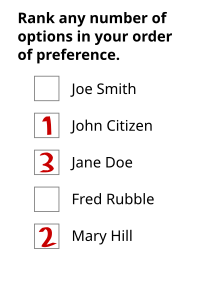
As for the House of Commons, which is what we are voting for tomorrow in Brandon-Souris, Provencher, Bourassa, and Toronto Centre, my feeling is that we need to go to a preferential ballot system. Basically, move the post. Nobody wins the election until someone gets 50% of the votes plus 1 more vote. My favourite is an instant-runoff voting system.

Basically an instant-runoff ballot would look the same as an existing ballot, but instead of putting an “X” by your choice, you number them in order of preference (see Wikipedia* picture to the left). Basically you get to vote your conscience, even if your preferred candidate has no chance of actually winning, yet you also get a strategic vote, because your second, and third (4th, 5th, etc) are also recorded.

So, let’s look at how this affects the real world. Here in Brandon-Souris we have a five person race happening; Larry Maguire for the Conservatives, Rolf Dinsdale for the Liberals, Frank Godon for Libertarian, Cory Szczepanski for the NDP, and David Neufeld for the Green Party.

Now, as of today it looks like Dinsdale has 50% of the vote. If that is true and he was the first choice of 50% + 1 voters, then he would be the winner, election over. But let’s say for a moment that the race is 46% Maguire, 44% for Dinsdale, 7% Szczepanski , 2% Neufeld, and 1% Godon. In our current system, Maguire wins. Hey, 46% is a good number and we routinely elect entire governments on less than 40% of the vote and then comically call it a landslide victory. Now, for ease of numbers, lets say that all of Godon’s voters pick Maguire as their second choice. Another round is counted, and now we have 47% for Maguire, with the other three staying the same.

Third round. Neufelds voters all picked Szczepanski as their second choice. Now we have Maguire 47%, Dinsdale 44%, Szczepanski 9%. Maguire still has not broken the barrier of 50% +1. Fourth round. Again, for easy numbers, all of Neufeld’s voters picked Dinsdale as their third choice, and all of Szczepanski’s voters picked Dinsdale as their second choice. In this final round the results become Dinsdale 53%, Maguire 47%.

Dinsdale wins.

Now, some will argue that it is unfair to Maguire because he originally had more votes than Dinsdale. Yes, that is a valid point. But it is also a valid point that with the choice of only Maguire and Dinsdale, more people prefer Dinsdale. What it in essence does is it forces candidates to appeal to more than their base to win an election. Sure, your base can get you a good part of the way their, but you need to broaden your appeal to actually get elected.

The other advantage of this system is that I think it is the easiest to implement. It requires the least change to our electoral system, and it has the least probability of needing a constitutional amendment to enact it.

This present system has produced huge “landslides” for the (Progressive) Conservatives and the Liberals while actually getting less than half of the population actually voting for them. It needs to end.

*graphic from http://en.wikipedia.org/wiki/File:Preferential_ballot.svg

Checked the mail…

Found this in my mail today…

torymailersmaller

Any guess which party it is from? Of course, it is the Conservatives. Not sure how they figure this will work.

I see two problems with this.

1) They possibly just sent mail to a bunch of people who like to smoke weed but that do not pay any attention to the news, that there is a political party that wants to make it legal. Will they vote? Perhaps not, but why take the chance.

2) The second statement is complete hokum. Ask any teenager what is easier for them to get; alcohol, tobacco, or pot; and the answer seems to be pot. Alcohol and tobacco are legal but controlled substances. There is no underground trade in alcohol or tobacco because most of the people who want it can buy it legally from a store. Seems to me that marijuana should be treated the same way. I truly believe that making marijuana legal for adult consumption will actually make it harder for kids to get, not easier.

Frankly, the Conservatives lose me more each day with their tenuous grasp on reality. Their logic is flawed. To me, it is an ad about why I should vote Liberal.

Ramblings on the Brandon-Souris byelection…

Brandon-Souris will be having a by-election on November 25, 2013 after the Prime Minister dropped the election writ for 4 ridings a week ago.

The lead up to this election has been interesting to say the least. When former Brandon-Souris MP Merv Tweed resigned his seat back in August, it was a forgone conclusion that the next MP for the area would be the person who managed to win the Tory nomination process, which promised to be the real race to watch in this constituency. Except for a blip in 1993 when the Reform Party was splitting the vote on the right, allowing the Liberals to shoot up the middle, Brandon-Souris had always voted for the Tories.

For most of that time, The Progressive Conservative Party of Canada was THAT party. At one point I was a member of that party.

Now, I would describe my political leanings of that time as a fiscal conservative with some doubts (in fact major doubts) about the social agenda of many on the right. While I had interest in following the antics of the Reformers, deep down I knew that I would never fit in that party. The social platform of the party was just too far right of my personal beliefs.

I was what you would call a Red Tory. The leader I would identify closest with in the party would have been Joe Clark. For a politician he was unusual. He worked hard to get his job done, something I had seen during the dying days of the Meech Lake Accord. While every other politician, including his boss Brian Mulroney, were busy posing for photo ops, Clark was actually busy trying to get the accord to work. He seemed to work hard and wasn’t looking for the glory. It is perhaps why he is one of our shortest serving Prime Ministers. He wanted to do what was right and needed, instead of what was popular.

He was also what you would call a Red Tory.

On the topic of my social beliefs; they have evolved, much like my religious beliefs. I had probably always had my doubts about the Judeo-Christian belief system that I was brought up in;’ you know, that niggling sensation that something just doesn’t add up. So, over the years I have moved from being apologetic for Christian beliefs, to calling myself agnostic, to pretty much referring to myself as an atheist. Having grown up with an interest in mathematics and computers, the scientific method has been ingrained in me enough that I have to follow the evidence. And the evidence says that there is not evidence to support that the Bible is anything more than a best-selling fiction book. Not very well written either. I recently completed reading Genesis and it hurt my head.

So, back to politics. It is with my slow evolution from religious apologist to secular humanist that I have found that I can no longer support the social stands of the right leaning politicians of this country. I believe in the separation of church and state, freedom of thought and association, and when in doubt about something that you should follow the evidence where it leads. Despite this deviation from the political right, I was and still am a fiscal conservative. I believe that governments need to run with reasonable to no debt loads in order to not burden future generations.

In 2003, Peter McKay succeeded Joe Clark as leader of the Progressive Conservatives and by the end of the year the party was gone, merged with the Canadian Alliance Party to form the Conservative Party of Canada. While technically a member of the new party, I had never asked to be and soon let my membership lapse as it was apparent that the party had went further right than I was comfortable with.

Much like former Prime Minister Joe Clark and my local Brandon-Souris MP, Rick Borotsik, my feeling was that I had not left the party, it had left me.

Now, during all this time in the 1990s and 2000s, it was actually apparent to me that the Liberal Party of Canada from a policy standpoint was probably most in line with my own personal political leanings. They were a centrist party, with both right and left leaning members. It was their really obvious feeling of entitlement that turned me off. It left a bad taste in my mouth the way they seemed to feel that they deserved to govern, and not that they needed to earn our trust. I couldn’t bring myself to vote for them. When I could no longer vote Conservative I jumped all the way to the NDP because, despite their obvious shortcomings, I knew what the NDP stood for. The Liberals never seemed to stand for anything. In 2006 they were punished for that attitude.

So, now it is October 2013. The Liberals have been through a handful of leaders. It is obvious at this point that they have now got the message that they have to earn the trust of the Canadian people. They no longer believe that they can make a gerbil their leader and that said gerbil will eventually become Prime Minister. While I believe that former astronaut Marc Garneau would have been a great choice for leader, it is becoming more apparent to me that Justin Trudeau has a lot of potential. Most importantly to me, this new batch of Liberal leadership supports evidence based solutions to real problems; not old tired rhetoric that has been disproven again and again. “Tough on crime” for example sounds good, and even has its place, but the evidence says otherwise when it comes to our justice system. The Tory muzzling of the nation’s scientists to the point that environmental experts are not allowed to discuss man made climate change is ridiculous. I cannot support it.

The NDP is not a reasonable option for me, and any belief that they have a chance in Brandon-Souris is laughable. Unfortunately, in our “first past the post” system, a vote for the NDP or the Greens is a vote for Larry Maguire and the Conservatives.

Back to that Tory nomination race. Three people were running, two got disqualified despite one of them having already pulled out, and Maguire was acclaimed. I don’t know if their were shenanigans, but it sure seems like there might have been. There was a lot of smoke for there to have been no fire. Whether or not his campaign was clean, Maguire’s nomination has a smell of taint, and that has allowed the local Liberal candidate, Rolf Dinsdale, to all of a sudden look like a contender. Even a recent poll puts Dinsdale in a possible lead.

Now, while still an uphill battle, Dinsdale has a couple of things in his favour. Name recognition can be a great help, and Rolf’s father Walter was our Progressive Conservative MP for 31 years. The Liberals have a young new leader who also has a political legacy in his father. Pierre Elliot Trudeau was one of this country’s longest serving Prime Ministers, and while his economic legacy could be described as a disaster, his social agenda and legacy defines the Canada we have today. While our southern neighbours are fighting over things we decided years ago, we have become more like the “Just Society” that Trudeau Senior described decades ago. If Justin Trudeau has just a small amount of the leadership qualities of his father we could be in for an interesting future.

Dinsdale also has the fact that Brandon-Souris is not as far right leaning as much of the rest of the area. When much of the West went Reform/Alliance, Brandon-Souris stayed Progressive Conservative. We only went Conservative when the old PC Party ceased to exist. To me, the Liberal Party of 2013 is the obvious place for a “Red Tory” to park their vote. They are after all the party who balanced the federal budget. With the Conservative move further right, it seems to me that the Liberals sit exactly where the old Progressive Conservative party used to exist.

On October 12, 2013 I bought a membership to the Liberal Party of Canada, and on November 25 I intend to vote for Rolf Dinsdale as our next Liberal Member of Parliament.

Newer posts »