Living, Working, and Wasting Time in Southern Manitoba

Category: Uncategorized (Page 2 of 4)

What to do with an old “New” Target?

So, what’s to become of that Target location at Shopper’s Mall? Hell, what about the old Safeway?

Former Brandon Target, Zellers, Walmart, and WoolcoIt’s a big question, and like StarFM’s Tyler Glen wrote in today’s paper, many in Westman have a long list of places they would like to see in town.

I have my own ideas too. Top of my list are London Drugs and Sears. There seems to be a rumour that Sportcheck is going to move in to the old Safeway, but let’s pretend for a moment that the rumour is false. If that is the case, then that would be the best location for a London Drugs. With that in mind, my hope would be that Brandon could land both retailers.

Why London Drugs and Sears? Frankly, we need more general merchandise stores, and in particular, quality family apparel. Sears fits into a niche that Brandon has not had since Eaton’s left in 2000, a major department store with higher quality clothing for the whole family, appliances, and full service cosmetics counters. As a former Eaton’s employee, I know for a fact that those cosmetics counters were quite lucrative in this city, a fact not lost on Sears such that a few times a year they park a temporary Clinique or Estee Lauder counter right down in that same mall.

Now, the fact that Sears has been seen as a declining company the last few years has not been lost on me, however, unlike Eaton’s I do not think that they are going anywhere. Canadian’s still need places to shop, Sears is still very solvent, and I have reason to believe that their new management has a good plan to get them out of the product lines that have been dragging them down. And let’s be honest, Brandon shoppers would flock to Sears if they opened here. Sears has everything that Target promised, but has a history of actually delivering in Canada and a tried and tested distribution network.

So, what’s the problem in Brandon? My guess is that the biggest problem is renovating a store to actually be a Sears. Sears and Target look different, and spending money on what some would consider an experiment might be considered to big a gamble. Also take into account that the Target location may not be big enough for a “full line” Sears store and you may see what hold the company back. Expensive renovations and not being able to deliver the “full concept” might be what gets in the way.

I have a solution.

Kmart.

What? Where the hell did that come from? Actually, from Sears. Sears Canada’s parent company in the States, Sears Holdings, used to be named Kmart Corporation before it bought out Sears a number of years back and changed its name. Kmart bought Sears and now as a result, Sears own Kmart.

So what does that have to do with Brandon? Lots actually. The Kmart brand has been gone from Canada for almost 20 years now, but Canadians are familiar with it and have memories of shopping there. It is a known brand that can be refreshed. It’s colours are also closer in line with Target, in particular red. Opening up a Kmart store in Brandon would allow Sears to redefine the Kmart brand in Canada as a leaner version of Sears as opposed to what it was when it left, reduce significantly the amount of renovations needed to open the store considering the current renovations are only two years old, and give the company a way to be in smaller communities such as Brandon that are big enough for more than a catalogue store, but perhaps not the full line. I suspect that there are five or six cities in Canada at least that the concept could fit into, and it gets the company into some markets that would support it very well. I think that properly executed, they could be some of Sears Canada’s best performing stores.


As for London Drugs, my feeling is that they are a nice sized store that would work well in Brandon. It puts a pharmacy back in the mall, along with one of Canada’s major electronics and photo retailers. Every time I’m in St. Vital mall, I am impressed with how diverse London Drugs is in a relatively small footprint that would easily fit where the old Safeway was. Not to mention that they are a solid Canadian based retailer that understands the Canadian market and whose distribution network passes right through our city. In short, I’m surprised that they are not here already.

The free ride should stop

Religious freedom is not under attack in Canada.

Just because some religious folks are now being challenged about their beliefs, or about the special treatment that religion gets in our society, does not mean that religion is under attack. Despite that, yesterday in Ottawa you would have thought that religion had been under intense attack by “atheist fundamentalists” for years now. I’m not even sure what an atheist fundamentalist is.

In recent weeks, James Lunney, the MP for Nanaimo-Alberni left the Conservative caucus in the House of Commons to sit as an independent because he had been feeling muzzled about his religious beliefs. He then subsequently tweeted his thoughts on evolution. He doesn’t believe in it. When people started responding to him on twitter he got angrier, and among his tweets said

which got more people calling him out.

Unfortunately the good Doctor (of Chiropractic) does not understand what a scientific theory is. Evolution is a fact. There is enough evidence to support that evolution has happened and is happening. Contrary to his belief, we have observed evolution in the laboratory and in nature. The Theory of Evolution by Natural Selection refers to how evolution takes place. We believe, and we have mountains of evidence to support it, that evolution happens through the process of natural selection, where the most beneficial traits in a particular natural situation that allow an organism to adapt to that environment favour that organism surviving over others in the same ecosystem. The theory explains much of the evolutionary fossil record that we have observed, and nothing in that record contradicts it.

What Mr. Lunney does not understand is that at no time during this debate has his religious freedom been under attack. Religious freedom does not mean that you get to say any ridiculous thing that you want and that nobody can challenge you on it. Mr. Lunney can think anything he wants, but that does not mean that other people cannot tell him that they think that he is wrong. That is all that has happened here. At no time was Mr. Lunney prevented from practising his religion. He has made up a controversy.

So, yesterday Mr. Lunney stood up in the House and asked to speak on a point of privilege. The Speaker questioned whether it really was a point of privilege, but eventually he was allowed to say his piece. Of course, CBC’s Power and Politics got a hold of the story and convened the following “debate” a short time later.

The debate was between Ian Capstick and Charles McVety. Mr. Capstick gets very passionate about his views in this exchange, and there is a point that he probably goes over the top, but for the most part he sticks to one simple fact; why do religious organizations get charitable tax breaks from the Government to support their religion?

It’s a good question… and it is never answered. Mr. McVety through most of the interview keeps personally attacking Capstick as an atheist fundamentalist and against Canadian values. He never answers the question. It is a valid question.

Now let’s be clear. Religious organizations do a lot of good work in Canada and abroad. By all means they should be able to register an arm of their organization as a charity to further that work. I have no problem with that. What I do have a problem with is a church, synagogue, mosque, or other religious group getting a tax break just for being a place of worship. It is not right for the taxpayers of the country, of the province, and yes even of the city or municipality to be forced to fund a faith group that they do not belong to. It’s government supporting religion. It’s not acceptable.

It’s not just federal tax breaks either. As said before, local government is in the same game too. In the City of Brandon for example, a look at the tax map will show a glaring discrepancy. Take Brockie Donovan Funeral Directors, looking at the data on the City’s own web site, the net tax bill for that property was $26,857.63 with City and School taxes taken into account. Across the street, Central United Church, an arguably larger building but with a much smaller parking lot, is billed $1,530.50 which is down from the year before. Yes, Brockie Donovan is a for-profit business and as such should probably pay more than the church, I’m willing to go that far. However, over 17 times more seems ridiculous to me, especially when it could be argued that the two organizations are in very similar practices. In fact, I suspect that over the course of a year, Brockie Donovan conducts many more “religious services” to many more denominations than does Central United Church. The discrepancy seems incredibly large to me. It may not be popular, but the practice of government funding religious organizations through obscene tax breaks can and should be questioned.

As a proud Pastafarian, using this logic, I could open up a Church of the Flying Spaghetti Monster downtown, complete with beer volcano and bar, and expect the taxes of the Double Decker and of The Dock to support my “church”, blatantly unfair to them, but discriminatory against Pastafarians if not allowed in the current environment.
Asking religious organizations to play by the same rules is not an attack on religious freedom, it is a demand of equality.

Same old Federal Liberals

My flirtation with the Liberal Party of Canada is over. I was going to give them the benefit of the doubt. I thought that maybe things would be different. I thought maybe they had learned their lesson.

They have not. They are the same old Liberal Party that I couldn’t vote for in the past.

On paper, the Liberals have always been the party that seemed to most mirror my own outlook on things. The Canada that they purport to envision as a land of equal rights and equal opportunity is the same grand vision of Canada that I hold. The problem is, they never deliver. They always campaign one way and then govern another. You never know which way they are going to go. They have no conviction.

In my last two entries, here and here, I shared my doubts about the statements by Liberals Justin Trudeau and Marc Garneau, when they defended a person’s right to wear whatever they want. I had this strange feeling that when push comes to shove, they didn’t really mean it.

They don’t.

The proof, Bill C-309, the “Preventing Persons from Concealing Their Identity during Riots and Unlawful Assemblies Act.”

From Wikipedia:

Bill C-309 is a private member’s bill, criminalising the actions of protesters who cover their faces during tumultuous demonstrations and introducing a five-year prison sentence for the offence introduced before the Canadian House of Commons in October 2011 during the 41st Parliament. On February 15, 2012, a 190-97 vote confirmed that the bill would enter a second reading and be sent to the House Standing Committee on Justice and Human Rights.
The proposal was introduced in the context of the 2012 Quebec student protests, and the riots following the 2011 Stanley Cup championship in Vancouver. However, in both circumstances a vast majority present were not wearing masks.
On June 19, 2013, Bill C-309 became law, banning the wearing of masks during a riot or unlawful assembly, carrying a maximum 10-year prison sentence with a conviction of the offence. The Liberal and Conservative parties voted unanimously in favour of the legislation. The Bloc Quebecois, Green Party and NDP cast 96 votes against the bill.

The Liberals voted unanimously in favour of the legislation. They voted for a law that would allow for a 10 year prison sentence based upon what someone was wearing.

10 year prison sentence! For wearing a face covering!
The Liberal Party of Canada supports that!

Yes, so do the Conservatives, but they are not the ones who have spent the last week saying that they would defend a Canadian’s right to wear whatever they want on their face. Which way do you want it guys? You can’t say that one set of Canadians get to cover there faces anywhere and everywhere and then not allow the same right for everyone else. Think about it, anyone who claims to be wearing a face covering for religious reasons gets to go home, while all others face up to a 10 year prison sentence. This is not hypothetical, this is the law of the land.

All of this has been brought to the fore because the Conservatives have been pushing through their anti-terror bill, C-51. Those such as myself believe that the bill is just the Conservatives pandering to their base, enacting unneeded laws to combat a problem much smaller than they purport it to be. The new bill tramples individual liberties in the name of battling terrorism. Most law experts from various universities across Canada believe the bill is too far reaching, and like other Conservative bills of late, runs amuck of the Charter. The Liberals have also said such things. They believe the bill is flawed. The bill is most likely what caused them to go on their latest offensive about the culture of fear that they say the Prime Minister is creating.

They’re also going to vote for it. You don’t vote for something you’re against… unless you’re afraid of losing votes. Well, they’ve lost mine.

They do not stick to their convictions.

So now, do I choose the NDP or the Greens?

Still contemplating what’s reasonable…

For some background, one should read my previous post, “What’s Reasonable?”

Let me be clear, I do not think that someone should be required to remove a hijab in a court room, in a citizenship ceremony, or elsewhere in Canada. Like my spouse has said, “If you can see someone’s face, what the hell difference does it make?” And really, that was the point of my previous post, that what someone wears on their head should be their own business if it is not interfering with the rights of others. My further point is that we should not be making that distinction on religious grounds. If someone wants to wear a hat or any other secular head covering in any of those same places, then they should be allowed to.

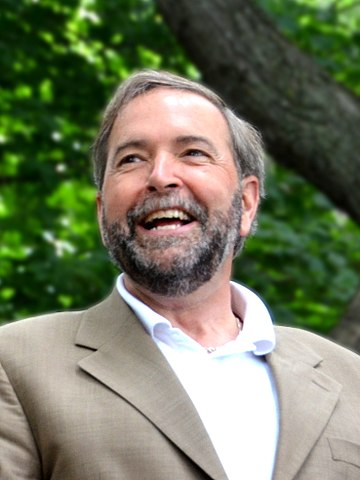
Tom Mulcair of the NDPAs this week has went on, this debate has exploded into the news, egged on by both the Prime Minister and Justin Trudeau, aided and abetted by Tom Mulcair. The issue this week is more to do with the niqab, a full face covering with only the eyes visible, as opposed to the hijab which leaves the full face visible. The rhetoric has been turned up quite a bit.

Now, the prime minister has framed this argument as being about womens’ rights. It would be a laudable argument if I thought for one moment that the Conservatives were actually pursuing the issue for womens’ rights. I have a hard time believing it. When the PM says that the niqab comes from a place that is anti-woman, he is not telling an untruth. It is a patriarchal practice, not actually required by Islam, that limits the way that a woman can dress. Yes, I am aware that some women will choose to wear the Niqab, but my gut tells me that the majority wearing it have been coerced somehow into making that “choice”. I really do not know where to stand on this one, while I respect someone’s right to choose, I would like to know that they are actually getting to choose. If there is a threat, implied or real, in their community if they do not wear the garment, then it is not a real choice. Banning the niqab seems extreme, but I have to wonder sometimes if there is an argument to me made.

As for citizenship ceremonies, it has been pointed out that identity is confirmed when completing required documentation, so perhaps if one is wearing the niqab of their own free will, then that should be the end of it; that is what the Federal Court has said.

But this is where I start to have problems with our left-of-centre politicians. At this point in my life, I lean to the left. Truth be told, I’m probably quite left on some issues. I previously stated, I’m also an atheist. I wholeheartedly agree with Trudeau, Mulcair, and even Marc Garneau, who tweeted earlier this week.

Marc Garneau, LiberalNow, I’m quite sure that he was talking about the right of a woman to wear whatever she pleases. Considering the way that the week has gone, it would not be a bad presumption. This is where I question the legitimacy of such a statement.

Again, a hypothetical situation. What if I decide one day to go to the mall. I walk around to various stores, look at some things, buy some others and go home. Sounds pretty normal. What I didn’t mention is that whole time, I was wearing a ski mask.

Is that okay?

Sure, it’s weird. A ski mask inside a store serves no useful purpose. It might make people nervous. But, should someone be allowed to ask me to remove it? If I refuse, should I be arrested? Being weird is not a crime. Sweating like a pig under the damn thing, while uncomfortable, again is not a crime. My reasons for wearing it should not matter. If I want to wear it, of my own free will, then I should be allowed to wear it whenever or wherever someone would be allowed to wear a niqab. To allow less, would be religious discrimination. The fact that I do not get to do something a religious person does is discrimination based on the fact that I am NOT religious. It is the same thing.

Would Mr. Garneau defend me in that case if i came and begged him? His statement says he would, my gut says he wouldn’t.

My main point again is this. Religious rights are great if they are applied equally and fairly to everyone, otherwise they are religious privileges. That is not okay. Again, as an atheist, it seems ludicrous to me that we would make laws and award privileges based upon a deity that in all likelihood doesn’t exist. I find it extremely perplexing that the pre-amble to our constitution mentions the Judeo-Christian God. If that is not privilege, I do not know what is. My opinion is that it even weakens the document. Canada should be a nation based on the rule of law, God should not enter into it.

On the other side of this argument is Mr. Harper and the Conservatives. At the end of the day, I cannot vote for them. Bill C51, the antiterrorism bill, just goes too far in so many ways, and is just the latest in a number of bills that I suspect go against the Charter. This government has a history of attacking Charter rights in the name of security or law and order. Historically, they also have a decidedly Christian slant to their party. It would probably be fair to say that their opposition to the niqab is probably more about who wears it and what their religion is, than womens’ right. I’ve frankly had enough of that behaviour.

So, I still don’t know what is reasonable, but I also suspect that a lot of people who have decided in their mind what is reasonable, would actually not be very reasonable when it comes down to it.

I’m still confused.

Crossing the floor

I really need to remember not to read the comments section on news stories.

The floor of the House of Commons - WikipediaThis morning, Eve Adams, the Member of Parliament for Mississauga-Brampton South crossed the floor from the Conservatives to join the Liberal Caucus under Justin Trudeau. Now, I have no idea what kind of MP Ms. Adams is, although I have heard that she has had questionable dealings in and with her former party during the nomination processes in her former and neighbouring ridings. Apparently she broke some party rules, however from past experience I know that that can be a murky mess too. Brandon-Souris had its own nomination irregularities in the last by-election which still seem questionable to me. But that’s another topic.

Just like any time that someone crosses the floor to another party, or leaves the party to sit as an independent, you start to hear people saying how dishonest the floor-crosser is, how they should resign and run again. The idea is that the representative ran under the party banner and got a bunch of votes from people who voted for that party.  That’s what I saw in the comments section, except with more name calling.

One problem. We don’t vote for parties in Canada, we vote for candidates. I really wish that people would catch on to this when they make these assertions. When you vote for a candidate, you vote for that person to represent your constituency. You do not vote for a party to represent your constituency. If that was the case, when Merv Tweed resigned his seat, then the Tories could have appointed someone to “their seat”. They were not allowed to do that, there had to be a by-election, because the person who held the seat vacated it. I really wish these commenters would learn how our system works before they comment. Eve Adams has the right, perhaps even the responsibility, to cross the floor if she thinks that the party she represents no longer represents her constituents. I don’t know if that is what has happened in this case, perhaps she is just an opportunist who jumped ship when she had pretty much been tossed overboard. Time will tell.

However, the right to “cross the floor” is one of the few threats that an MP has against their party, especially a party in government. It is something that is an integral part of our system.

Personally I would go further. I would like to see the removal of party names from our ballots. To me, the party name is a form of advertising for the candidate. Political advertising is forbidden by law inside or within so many metres of a polling place. Some will say that the party name beside the candidate lets people identify who they want to vote for. I would argue that if you have not been able to figure out who is the representative of your favourite party before you go into the polling place, then perhaps you have not done due diligence in researching and knowing the positions of the candidates in your area. If you cannot even identify the political affiliation of someone that you want to represent you, perhaps you don’t know them well enough.

I would hope people would put more thought into their vote than just picking a colour.

Sometimes tech isn’t the answer

It’s no secret that I love technology. My job involves selling and repairing PCs and Macs. I am a regular listener to two podcasts on the This Week in Tech (TWiT) network online. I spend many hours in front of a screen.

I am a tech geek.

That being said, I have never understood the fascination that some people have with trying to introduce technology into the voting process. To me it seems that it is an unnecessary use of technology. Voting isn’t broken, we need not fix it.

Case in point. Yesterday, the province of New Brunswick held an election. Apparently they were using vote tabulating machines. Apparently polls closed last night and results started coming in quite fast, which of course should happen when using a computer to count votes. Theoretically, if polls close at 8:00pm, you should have a result by 8:01pm; computers are very efficient at this kind of counting. This did not happen last night in New Brunswick. Poll results came in until 10:30pm and then stopped… for over two hours.

As a student and a user of technology, I know that it is possible to build a perfectly secure vote tabulating machine. I also know how hard perfectly secure would be. You need code reviewed by multiple people, checked and rechecked, secured against unauthorized changes, and a reliable and accurate paper trail created for each vote cast.

The first problem with electronic voting is that often it involves machines designed by private companies and the code is considered intellectual property and is not subject to public scrutiny. You need the code to be open to know that it is actually correctly written, bug-checked, and that no “secret” routines are included in it. The anchors on last night’s New Brunswick election coverage on CBC were very concerned about so-called “missing” memory cards in last night’s election. I understand their concern, however the cards were most likely just in transport and there are ways programmatically to ensure the cards have not been tampered with. If those precautions have been taken by the tabulator manufacturer then they need not worry. Unfortunately, how do we know that those precautions were taken?

As a proponent of a preferential or weighted ballot system, I am one of the first to realize that in such a system, computer counting may be needed to get a result in a timely fashion. I am not against the use of technology. What confuses me though is how some jurisdictions are relying solely on the machines. For example, last night the Progressive Conservatives were pushing for a hand recount of the votes; mostly because they were on the losing side of the count. My question however is why would you not hand count the votes anyway, every time? The computer should be used to make results timely (the machines should be faster most times, unlike last night), leaders can make their speeches, everyone can go home. But the paper count should always be done, with everyone acknowledging only the paper count as the official one.

Most people who understand technology realize why its a bad idea as the sole way of counting votes.

Give them some respect

Sometimes North American society confuses me; well, actually, most of the time. Case in point, our expectations and understanding of the younger generations. There seems to be something about “the adults” that they forget how it was when they were children, teenagers, and young adults. The worst seems to be how many adults see older teenagers and twenty-somethings as somehow unable to make real decisions about their lives.

Somehow we expect children and teens to make life decisions about education and career (I’m 40 and I’m still not sure what I want to do when I grow up), but when it comes to everyday things like what items they will consume or their sexuality, we somehow as a society seem to think that teenagers and young adults are unable to make good, well-informed decisions.

MillerBeerSFor example, today in the Winnipeg Free Press (and the Brandon Sun), there was an article about how the Canadian Centre on Substance Abuse (CCSA) was urging the province of Manitoba to consider raising the age of alcohol consumption to 19 years of age from the current 18 years. A government spokesperson responded, “We are not planning to raise the drinking age, which is 18 and the age of majority in all other respects.”

That is the correct response.

I do not like the actions of “helicopter parents” as it is. That is, those parents that have to be involved in, and have a say in, every aspect of their child’s life, even when that “child” is legally an adult. What I hate even more is when the helicopters start hovering over other people’s children and young adults. Raising the drinking age to 19 would be a nanny state imposing its will on citizens and voters that in every other way are considered adults. It is often said that if someone is old enough to join the army then they are old enough to have a beer. I happen to agree.

Yes, I know that anecdotal evidence should be taken with a grain of salt, but I do recall being a teenager and a young adult. What I remember is this. Those that had unreasonable curfews and rules set upon them tended to rebel the most against those rules and curfews. Those who were banned from any alcohol whatsoever tended to be the worst for using alcohol in irresponsible ways. Those of us who had no curfew and whose parents would say, “If you want a beer, have it with us,” we tended not drink very much and often got home at a reasonable time. Our parents expected us to have some responsibility and we met that challenge by actually acting responsible.

That’s the thing. Many would think that my parents set a low expectation by not putting those limits on me, but it was actually the opposite. They expected me to rise to the occasion and make decisions that were in my best interest. The other side of that was that when I made a questionable decision, it was my problem to deal with the consequences. If I got home at three o’clock in the morning on Friday night it was my problem if I had to get up at 4:30 to help milk the cows on our farm, not theirs. One soon learned to get home earlier.

This is the problem I see with raising the drinking age to 19 or to 21. It tells young adults that we do not trust them to be responsible with alcohol. When we set such low expectations, we should not be surprised when they meet them. The fact that Saskatchewan’s eighteen year olds come to Manitoba or Alberta to drink and then drive home is not Manitoba’s or Alberta’s fault. If Saskatchewan treated these adults as adults, then they would not have to leave their own town to begin with, and would not be as prone to binge drink when they were elsewhere.

Personally, despite the fact that I rarely drink, I think that our liquor laws and attitudes in North America towards alcohol are too restrictive. We treat alcohol as a forbidden fruit and then act surprised when people binge drink or abuse it in other ways. My personal opinion is that we need to teach more about responsible alcohol consumption and from an earlier age. For instance, it should not be seen as socially unacceptable or even illegal for a teen to have a glass of wine with their parents at a licensed restaurant.

Teach responsibility… it’s a lesson that can be carried throughout life.

Brandon Amusement Park?

Yesterday was our day at the Manitoba Summer Fair. The weather was beautiful and the kids had fun. I have to say though, it wasn’t cheap, and lines were long. It does make you think that perhaps early June is not the best time for a fair with a midway. Three of the five days are school days, therefore shorter, and that makes only two days that you can spend the whole day at the fair. When you pay that much for ride tickets or wrist bands, we chose bands, it makes you want to make sure you get your money’s worth.

Unfortunately everyone else has the same idea, and on a day without rain, it gets crowded. Last year was actually better because it rained halfway through and the uncommitted went home! I understand that the fair takes place when it does to secure North American Midway Entertainment’s services. I just wonder if there is an alternative, and would it be better for Brandon?

That being said, fairs do tend to be expensive, and lines long regardless of the time of year the event is held. Only occurring once a year, the Summer Fair is able to cash in on its limited time window. Believe me, I understand the market forces at work.

Every year, the midway does get me to thinking about something else. Could Brandon and Westman support an amusement park? I don’t mean a Six Flags or Disney size park, but a smaller park like Tinkertown in Winnipeg.

I think we could, if the location was right. There has for a number of years now, been repeated pushes for a Casino or a resort hotel, or both. People have also suggested a waterpark. We had a waterpark in the 1980s, however it was so far out of town that it was impossible to get to easily. I’ve also thought about a small zoo, Brandon once had one. In my brain though, it is a family amusement park that seems to have the most chance of working, and family entertainment is something that could be more available in our city.

Once a year during the summer months we take the kids in to Winnipeg and we go to Tinkertown. It is located on the east side of the city, just off the Perimeter Highway, interestingly enough, next to a waterpark. Tinkertown has both kiddie rides, 7 of them, and 13 family rides. The Tilt-a-Whirl, the Scrambler, Paratrooper, Spinning Apples (Dizzy Dragons with a different theme), miniature train ride, and bumper cars just to name a few. If Tinkertown was up on the North Hill somewhere, we would definitely go more than once a year. Heck, probably more than once a month!

The thing I like best about Tinkertown is the price. A wrist band for the day costs $15 per person. That’s $60 for a family of four, but it beats $152 plus adult admission at the fair. Personally, I think it could be a good venture, though I am not the risk taking type so I doubt that I would be the one to do it. If someone did though, I would be one of the first in line. I also think that it could be a good employment opportunity for area youth.

If you build it, we will come!

More radio choice, not less

Recently the group Friends of Canadian Broadcasting floated speculation that the Canadian Broadcasting Corporation was considering eliminating CBC Radio 2 as an over-the-air entity and would take it online only. FoCB routinely makes dire predictions about the CBC that seem to rarely come true, however it is good to have a group dedicated to keeping Public Broadcasting healthy and available in Canada.

CBC Radio 2 is the public broadcaster’s arts, music, and entertainment channel, while CBC Radio 1 is the news, talk, and information channel with some entertainment thrown in for good measure. Radio 2 at one time was known as the “Classical Music” service but has recently diversified into more forms of music. We often listen to Radio 2 Drive in the afternoon as an alternative to the Assiniboine College station CJ106; host Rich Terfry presents a good mix of modern rock, pop, and singer-songwriter music with much attention given to Canadian content. Great Canadian content. So the elimination of Radio 2, at least in our house, would be considered a loss.

The idea that CBC would take Radio 2 off the air and go internet only did not make sense to me. If you are still doing the programming then you are still spending the bulk of the money to reach a smaller audience. Most of our listening of Radio 2 goes on in our car, when we are away from a reliable internet connection at a reasonable price. Take away the broadcast tower, you cut significantly into the audience. Sure, you are spending less overall, but spending more per listener.

That is not efficient. It would be the wrong approach.

What should be looked at is a more effective use of the broadcasting assets and of new technology. This means adding more choice, not taking it away. This also means that the CRTC has to hurry up and approve newer technology after approving the wrong one over a decade ago.

Years ago Canada had a plan to move to digital radio, with a technology known as DAB that was and is in wide use in much of the world. Digital Audio Broadcast was an attempt to move away from the current AM/FM analog services to something with better sound quality and better use of bandwidth. It never took off. The problem? We live next to the United States and they never adopted the same system. South of the border they have opted to stay on the AM and FM analog frequencies while employing a new digital signal on top of the existing station. This hybrid means that older radios still receive the station’s regular signal, while newer HD radios receive a higher quality digital signal which can also supply extra information and even multiplex for extra audio streams.

So, what does this mean for the future of the CBC and Radio 2. It means that they should keep their current broadcast assets, the towers and the frequencies, and do the necessary upgrades for HD Radio. On AM, this means that Radio 2 could “piggy-back” on the signal for Radio 1; AM tends to propagate further than FM so it would be my assumption that it could reach more people, assuming that the signal would still carry as far. (I am not a broadcast engineer, my apologies if I’m wrong). edit: multiplexing only available on FM as far as I can see. As far as the FM signals go, Radio 2 currently has its own frequency. If you multiplexed another stream onto it, that would mean that the current online-only service CBC Radio 3 could be moved onto a broadcast platform. Radio 3 is a mix of new rock, pop, hip-hop, and alt-country. It is CBC’s new music station, available online and on satellite radio. Why not offer it on a broadcast platform?

Yes, I know that this all costs money. However, it seems that the future of radio in North America is this Digital-Analog hybrid known as HD radio. Some experts point out that the system has problems, and I would tend to agree. It has one important thing going for it though, consumers. To introduce a new system, consumers want to know that they will not lose what they currently have. If I put a new radio in my car for the new technology, I want to know that I will still receive Radio 2, Radio 1, CJ106, BobFM, Star, NCI, FARM,  and even CKLQ when and if I want to listen to them. I want more choice, not less.

And here is the wonderful thing about this move, it would possibly be good for choice across all stations. CBC Radio 1 could offer news and weather as a second stream all day long, a radio version of CBC News Network essentially. Bell could offer extra streams on its current stations. BOB’s second stream could be a rock station more akin to what CITI or Power97 are like in Winnipeg. Perhaps you could even call it KX96. The FARM could offer a classic country or oldies stream, as could CKLQ. Perhaps NCI could offer a stream aimed at Native youth. There are many possibilities here.

As our public broadcaster the CBC provides important services. They also can be the catalyst to making the Canadian radio industry have more choices, rather than less. It’s a better use of resources.

Two Governments; Two Attitudes

There were two very different laws in the news this week that concern what an adult individual can freely do with or to his or her own body and life.

The first law was actually a bill introduced on Wednesday by federal Justice Minister Peter MacKay, the Protection of Communities and Exploited Persons Act. The act is basically a replacement for the prostitution laws struck down by the Supreme Court back in December. The Court struck down the provisions on communication, keeping a common bawdy house (brothel), and living off the avails of prostitution, as it determined that those provisions of the law made sex work more dangerous. The Tories had a year to pass a new law, and this is it. The law makes communication illegal in most locations, makes it illegal to live of the proceeds of prostitution, and makes it a crime to purchase, but not sell, sex.

The second law in the news this week was the passing of bill 52 in the Quebec National Assembly. The “dying with dignity” law is the first law of its kind in Canada. It allows a framework for terminal patients in Quebec to ask for and receive medical assistance to die.

Both laws come down to a person’s right to choose. It is firmly my belief that an adult person of sound mind should be able to determine what they want to do with their own body. As a society we should try as hard as we can to help people avoid having to make these decisions in the first place. We should make sure that terminally ill people are as comfortable as possible and try to keep their quality of life as high as possible for as long as possible so that they need not feel that an end of life decision needs to be made. If that means making available powerful pain relieving drugs, including opioids, then we should do that. However, once someone has freely made the choice to end their own life, then we should respect their right to determine what happens to their own body. Quebec has got it right.

An adult person should also be able to decide what they are going to do with their own body with other consenting adults. I concede that many people are in the sex trade and participate in sex work against their will. As a society we should be making sure that these people have a clear and easy way out of this trade, or a way to avoid it altogether. Nobody should be in sex work that doesn’t want to be there. However, if someone has determined that they want to work in the sex trade, then we should respect their right to do so. It is not my place, or the government’s, to tell consenting adults what they can or cannot do with their own body.

There is a certain smugness to the prostitution bill. The Court told the federal government exactly the kind of bill that could not be passed, and the government introduced exactly that bill. The new bill actually reintroduces at least two of the three provisions struck from the original law, just reworded. The Court said that any provisions that made sex work more dangerous for sex workers would be unconstitutional. There is no doubt that this bill will make sex work more dangerous. Making the purchase of sex illegal, something that was never the case before, means that the purchaser will want to transact in more dangerous locations for the sex worker. There is no way that this new bill, after becoming law in a Conservative dominated House, will survive a constitutional challenge, and there is no way that MacKay doesn’t know this. That is the most maddening part, he is openly demonstrating his contempt for the court, which, as John Ivison points out in his National Post article, goes against his duties as Attorney General of Canada.

I find it disheartening that the Conservatives and their base abandon their core principle that government should stay out of the way of the daily economic pursuits of the populace. Apparently, that only applies if that economic pursuit does not make them feel icky or goes against their own religious or moral beliefs. I just don’t understand how their beliefs get to run roughshod over someone else’s beliefs. To me imposing your own moral code onto someone else who does not share it is unethical.

The other part of the prostitution bill that I find disheartening is the insistence of the government to confuse the matter by making this about child prostitution and human trafficking. Child abuse and human trafficking are already illegal, as they should be. I agree that any prostitution law should be crafted in such a way to minimize these occurrences, but this bill does not do that. By making the consenting adults criminals also, it makes the child abusers and human traffickers harder to find in the now larger crowd of lawbreakers.

What would have made more sense would have been a new law based on the “New Zealand” model where brothels are legal and health requirements including mandatory use of condoms are strictly followed. Add other protections for the safety and security of the workers as needed, including strict ownership rules for brothels. Not allowing recent immigrants to work in legal brothels would also help in the prevention of human trafficking in the industry. The Conservatives had a chance to actually help sex workers with real protections for their safety, but instead chose to play politics by playing to their base. It’s politics at its worst.

In the end, it all comes down adults choosing what they want to do with their lives. The government’s only role in this is to make sure that nobody is doing something against their will. A free society means at the very least the freedom to one’s own self.

Quebec seems to understand the concept; Ottawa does not.

« Older posts Newer posts »