Living, Working, and Wasting Time in Southern Manitoba

Category: opinion (Page 2 of 4)

Target Canada, what went wrong?

Target Corporation of Minneapolis, Minnesota announced what many suspected yesterday, but was still surprising; they would be closing their Canadian operation after less than two years in business. About 17,000 associates at 133 stores and 3 distribution centres would be losing their jobs. The term “epic fail” will refer to Target Canada for the foreseeable future.

What went wrong?

Many people have their theories, but what it really comes down to is that they failed to recognized that they were entering a different market, with different consumers, and a different attitude. The easiest way to understand what went wrong is to contrast the entry of Target into Canada with the entry of Walmart into Canada 19 years earlier.

The store here in Brandon at the Shopper’s Mall demonstrates the differences well, as it has existed as all three retailers, as well as Woolco since it first opened in the early 1970s.

When Target first announced it was entering Canada, it did so with the purchase of the leases of most of the existing stores of Zeller’s from the Hudson’s Bay Company. Target made a point of just buying the leases, pointing out it had no interest in the stores, or in the current staff. Any Zeller’s staff would have to apply for jobs with the new company. Part two of the plan was to renovate all of the stores at an average cost of $10,000,000 per store.

In 1994 Walmart announced that it was entering the Canadian market, it did so with the announcement that it was buying the discount chain Woolco, not just the leases, but retaining most of the company assets including employees and other infrastructure across the country. They modestly renovated the Woolco locations while remaining open, the biggest changes being replacing the cafeterias with McDonald’s locations. Walmart went on to become the dominant retailer in Canada.

What was the difference?

Walmart came into this country knowing that they were in foreign territory and that they would need Canadian expertise to help them succeed in the new environment. They didn’t come in and promise to open 133 Supercentres on day one, but instead integrated an existing trusted Canadian retailer into their corporate culture and ways of doing things. In the first year you would see Walmart associates with nametags that said “20 Years of Service”. Walmart recognized the importance of having a Canadian perspective right out of the gate. They also realized that Canadians would not expect a replica of American Supercentres, but would understand that Walmart would slowly but surely transition Woolco to a better retailer. They under-promised, knowing that the benefit would come later when they over-delivered.

Target should have known better. If you are the number two retailer in your home country, and you decide to enter a market that your number one at home is already in, you should probably follow their lead and copy their successes.  Target did not, but instead did everything the opposite that Walmart had years earlier.

Many have opined that Target made the mistake of buying the Zeller’s chain, with its run down image and locations. My take is the exact opposite. Target’s problem is that they didn’t buy the chain, but instead opted for its leases only. Had Target entered Canada the way of Walmart, then they would have bought the entire chain; stores, delivery centre, logistics, and yes, the staff. Had they kept Zeller’s intact, then they would have started out from a point of lowered expectations from which they could slowly transform into the Target they wanted to become. People would have seen the incremental changes, thought that they had improved upon Zeller’s, and would not have expected the American Target experience on day one. The other benefit, a fully operational distribution and logistics network. Absorbing Zeller’s would have prevented the problems that eventually ruined their reputation.

Perhaps the biggest expense that Target encountered in the Canadian rollout was the renovation of all of the previous Zeller’s stores. Now, there is no doubt that many stores needed a renovation, however, many did not. A good example of this were stores in Winnipeg and Brandon that had been renovated a short time before. Target in Brandon, MBThe Zeller’s store at Shoppers Mall in Brandon had opened in May of 2006 and closed in November of 2012 after only 6½ years of existence. The store had been fully renovated on the interior during the early winter months of 2006 to look a lot like a Target store. In 2013 Target completely gutted the store to the point that all that remained was the roof and pillars. After that they completely rebuilt it; it essentially looked the same as before, but without a restaurant. At an average cost of $10 Million per store, it was a colossal waste of money during which the store was closed and not bringing in a dime.

And the roof still leaked.

Another thing they would have known had they kept the Zeller’s team would have been the attitude of the Canadian shopper. The Canadian shopper is less about flashy and aspirational purchases which Target targets in its American stores, and is more about value for money. Another difference with the Canadian customer is that they do not tell you when you have disappointed them or made them mad. I have seen research in the past that said while an American customer will pester or even yell at a retailer, later buying if acknowledged, the Canadian consumer is more apt to stay quiet and just leave disappointed, never to return. Canadian consumers will also let all their friends know about the bad experience. Fail one of us, word gets around.

Target wasn’t prepared to enter Canada and they did not know it because they didn’t do their research. Walmart knew enough to know that they didn’t know the country and were willing to take it slow while getting to know us. While Walmart collects the fruits of its slow and steady remodelling of Woolco, Target leaves 133 empty stores where similar looking Zeller’s stores once stood. What would be really ironic would be Hudson’s Bay taking over the spaces with a revived Zeller’s brand, over 100 essentially new stores in your existing colours that you didn’t have to pay for building would be the retail industry’s coup of the century.

A Vision for Downtown

The Strand Theatre in Brandon has been vacant now for a while. For a number of years it was one of Brandon’s only 2 movie theatres along with the Towne Cinema down on eighth. With the opening of the Capitol Theatre by the Shopper’s Mall and its later expansion, the Strand was eventually closed and has sat unused ever since.

A few years ago Landmark Cinemas, owner of the building, agreed to sell the property to The Brandon Folk Music and Arts Society to develop it into a new arts hub for live performances. I have been a proponent of the idea for a few years, but it seems that the plan brought forth by the group is not catching the public’s attention. It has languished for years now. Shaun Cameron, regular columnist for the Brandon Sun wrote a piece last weekend urging for a renewed effort, and perhaps a separation from the Arts Society. A repost can be found at his blog.

This got me to start thinking about that whole block, and the surrounding area. There has been a lot of change down there in the last few years. The YMCA moved in to its new facility over a year ago; some kinks had to be worked out, but it is an excellent facility. The Kristopher Campbell Memorial Skate Plaza is a popular gathering place for city boarders in a spot that since 1980 had been a gravel parking lot. The Brandon Inn, its best days long behind it, has been torn down after being condemned and then inherited by the city. Thunderbird Bowl moved out of its old location underneath the parking lot at 10th and Princess, and the Brown Block immediately beside the Strand has been demolished after collapsing a few years back. Even the Brandon Real Estate Board moved out of their building so that a large block of land immediately south and southeast of the Strand are now vacant. The Thunderbird lot is still there, as is a barber shop that was partially attached to the Brandon Inn. There is a fairly large lot now available for development. My feeling is that the whole area has been envisioned by someone for development that would compliment the Strand project if it ever gets going. I have thought over the years what the possibilities could be for such an area.

The fist thing that I wonder is whether or not the Strand’s main entrance and a second marquis could be built on the south side where the Brown Block used to stand. There is presently a structure there that holds the strands south wall up that it used to share with the other building. Perhaps a new  modern atrium could be built in this area that would provide the necessary structural support for the original building, and provide more room in the winter for patrons to gather before and after a show. It would also connect the Strand to a new outdoor park that would encompass the entire south end of the block. What I see in my head is an outdoor summer concert bowl that shares the Strand’s facilities for offices, dressing rooms, and other amenities, while providing a permanent stage for events such as the Folk Festival and hopefully, if it continues, BUSU’s Rock the Block festival in September. This new facility would serve as a new “city square” where a multitude of other events and concerts could be held. I would also reverse the direction of traffic on 9th street so that it was one way going north between Princess and Pacific avenues. During an event, there would be gates south of the Skate Plaza on 9th that would close, and on Princess between 9th and 10th. Eastbound traffic on princess would be directed north on 9th. This way, Princess Park, the Skate Plaza, and the Concert Bowl could be treated as one big property during larger events. The last thing I would want to see is a nice brick and iron fence along Princess and 9th streets that would keep pedestrians out of traffic and avoid a tragedy like we had a few years ago during an event in Princess Park. At the time I thought that it would have been a good use of reclaimed brick from the Brandon Inn to build such a fence at minimal cost.

I have no idea if any of this has any chance of ever happening, and I obviously do not have the capital to pursue such a project, however, if an idea is never suggested, it can never be acted upon. That is all this is, an idea of what could be possible. I’m not saying we should do it, just that we could. I am in total agreement with Mr. Cameron, the Strand project is a good idea for this community. It can be the start of a re-birth of downtown if done right. Downtown will be healthy and vibrant if we transition it to a residential and arts district.

Do this right, and people will want to be downtown.

Questionable Problem, Wrong Solution

Reduced speed limits in school zones came into effect this past September across Manitoba. The provincial government had earlier passed a law enabling local governments to reduce speed limits next to schools if deemed necessary. Of course, not wanting to look like they didn’t care about the children, many local councils including the one in Brandon p26th Street Southbound at JR Reidassed such a bylaw.

The signs went up in August.

So, of course,  the debate started on eBrandon.ca and twitter the first week of school. Predictably there are a number of people who think that the whole thing is just a money grab with increased speeding tickets, with others arguing that we should do anything we can to keep the children safe. To be frank, I think the truth is somewhere in the middle, but I question if it was really a safety issue.

So, let’s actually do something that makes children safer. I’m not convinced that this is it. I think a better idea is higher fines in school zones for speeding, as does former Brandon city councillor Stephen Montague, as pointed out in this June 6, 2014 editorial in the Brandon Sun.

“While signage is a minor concern, we think Coun. Stephen Montague (Richmond) wasn’t wrong when he suggested there could have been other options to lowering the speed limit, like keeping the limit the same but increasing fines for speeding in school areas.

He also said better enforcement of no-parking and no-stopping zones near schools where stopped vehicles narrow the path for passing cars and limit lines of sight could also provide a benefit.”

This becomes really apparent on 26th Street in front of J.R. Reid School. As you approach the school from the south you cross Park Avenue which is a lighted intersection, and immediately enter the school speed zone. It seems possible to me that at some point as drivers slow down through the intersection that someone is going to get rear-ended by someone else more worried about the lights and less about the zone. I could very well see the accident numbers going up at this intersection as a result of this speed change.

I’m also not convinced that the speed limit had to be reduced. Again, at J.R. Reid it never appeared that people going the previously posted speed limit of 50km/h were ever a problem. I’m sure that there were problems with speed, but I’m guessing that the problem was most likely people going 60km/h or more in that zone. Yes, technically the drop to 30km/h makes the spot even safer, but I sense that it is already pretty safe. Again, the Brandon Sun looked into this city wide, and from that same editorial:

“But there don’t seem to be any major injuries or deaths in Brandon school zones in nearly a quarter-century.

As we reported yesterday following a search of the Brandon Sun archives, two children were killed by vehicles in recent years, but neither incident was outside a school.

The closest fatality to a school that could be found was in March 1991, when a five-year-old boy was hit on Knowlton Drive — on a Sunday —after walking into traffic from between parked cars, in front of the Sportsplex near Kirkcaldy Heights School.”

It seems to me that we are dropping the speed limit to prevent accidents that are not happening, and I would expect that we will see an increase in rear-end collisions as a result. It would not surprise me in the slightest if this costs Manitoba Public Insurance more money in the long run. Those of us who obey the posted speed limit were never the problem, in fact it seems that there wasn’t actually much of a problem. If in there was a problem, then Victoria Avenue and 18th Street would have a 30km/h speed limit next to Earl Oxford School as one would suspect that to be the most dangerous school zone in the city, yet we do not reduce the speed limit in that area. That tells me that the other zones are not about safety but about the appearance of safety. “Safety theatre” I would call it.

We already have double fines for speeding in a construction zone, we could do the same or higher in a school zone. Signage in a school zone could read, “School Zone: Speed Fines X 4”. That would hit the problem drivers where it hurts, the pocketbook, and leave us other drivers to drive at a reasonable limit. It would also mean that Earl Oxford would have a safer zone as more people would observe the 50km/h speed limit.

The provincial government needs to revisit this law and provide for these higher fines in school zones. Local governments could then have the choice of reducing the speed (if it makes sense), or of multiplying the fines. Choose one or the other, but not both, depending on the school. Schools on residential streets actually make sense at 30km/h, like Meadows or Green Acres for example. However, schools like J.R. Reid, Earl Oxford, and King George, which are next to major routes, do not make sense to have a reduced speed limit; we should find a better solution.

Perhaps we start local

Election season is now in full swing. This past week saw the deadline for nominations for candidates in the upcoming civic election in the city of Brandon. We now have four candidates for mayor and various candidates for councillor throughout the city.

The Brandon Sun has started its full election coverage with a weekly feature questioning each mayoral candidate on various topics facing the city. This week the topic was infrastructure, which to readers familiar with this blog, is an issue I’m very interested in, especially transportation infrastructure within the city.

Mark KovatchAs a result of reading that article, I consider that Brandon has three serious candidates for mayor. Mark Kovatch, owner of Turtle Crossing Campground, answered the questions the clearest of the four. Frontrunners Mayor Sherri Decter Hirst and former councillor Rick Chrest had okay answers but you could tell that they are practiced politicians. John Paul Jacobson just didn’t connect with me. My feelings on that feature is that Mr. Kovatch was the clear winner in my mind, and I will now take a harder look at him as voting day approaches.

This again brings me back to a problem I had with the federal by-election last year, and our broken first past the post voting system. If I decide that I would like to eventually vote for Mr. Kovatch, I would like my vote to actually count. I would like other people who would like to vote for perceived third or fourth candidates to also feel that their vote counts for something. I would like to not have to consider voting strategically if there is a candidate that I could absolutely not want to be in office. This is why, as I’ve stated before, we need a preferential ballot system. My belief is that we need it at all levels, but I think the local level would be a good start.

For those unfamiliar with a preferential ballot, it works like this. Instead of marking an X next to the candidate of your choice, you instead number rank them. In the case of the mayoral election, you would number them one to four, 1 for your top pick and 4 for your lowest pick. In an election such as this one, where two candidates are considered favourites, if your first pick is not a frontrunner, and it comes down to the frontrunners, you still get a choice between them. I have in the past voted for someone who is not my first choice because they are the best chance to defeat a candidate that I very much dislike, but has a chance of winning. In the by-election, more people in Brandon-Souris voted for left leaning candidates but the right wing candidate got in. Had we had a preferential ballot, most likely our MP in Ottawa would currently be a Liberal.

As it appears by a quick reading of the Elections Act of Manitoba, we would need the province to amend the act to allow preferential ballots in Manitoba civic elections, something recently done in Ontario. Interestingly enough, it seems that preferential ballots were the norm in Manitoba for much of the early part of the twentieth century up until 1954/55 when they were changed for partisan reasons.

My thoughts are that if we had such a system, candidates like Mr. Kovatch, who might actually have people interested in voting for them, might make a much better showing. You may get a situation where such a candidate is actually the first choice of more people than a perceived frontrunner. It evens the playing field, if only just a bit.

My question for mayoral candidates and others running for Brandon Council is this,

 “Do you favour the adoption of a preferential ballot in Brandon before the end of the next term?”

We might find we get a better race.

Mr. Selinger, we need some upgrades…

As I write, Brandon is experiencing another “high water event” on the Assiniboine River. Torrential downpours last weekend in Saskatchewan and Manitoba has led to an overabundance of moisture in the watershed that feeds the Souris and Assiniboine Rivers, both of which feed through Western Manitoba, the Assiniboine cutting through the north end of Brandon.

As of this morning, the Assiniboine river is over Grand Valley Road west of the Corral Centre, and has resulted in the closing of First Street North as it curves around the river in the east. Eighteenth Street is down to one lane in each direction until this evening. For the second time in just over three years, we are a city cut in two.

This morning, Deveryn Ross, Winnipeg Free Press columnist and Brandon resident tweeted the following link to his new column.

In the article he points out that the province has made repeated promises for upgraded flood protection since 2011 and had promised us 1-in-700 year flood protection at one point which has been downgraded back down to 1-in-300 in limited areas.

Now, I understand why the city is letting 1st Street flood, there is simply not enough time or labour available to protect the street, they only had a day to do a job that in 2011 took weeks to prepare. It was simply an impossibility. For this event it is the right call; it is the only call.

However, when this event is over, we need to really pressure the province to bring this city up to a 1-in-700 year flood protection level. My expectation would be that that would mean we need to find a way to keep 1st Street at least partially open. It seems to me that the southbound lanes of 1st are probably not able to be upgraded as they are essentially on the riverbank. However, we have the northbound lanes which are far enough away to do something. I would like to see the engineering possibilities to raise the northbound lanes higher, up to the 700 year height level, but not as a dike, instead more of a causeway in places. That way the water could still flow past and under the street while keeping an extra artery to the north end of the city open, although at reduced capacity. First Street is a provincial trunk highway (1A) so the province should perhaps concentrate on getting something done to keep it open. Two lanes is better than none. They did after all promise that our city would receive 1-in-700 year flood protection after raising our PST rate by one percent. Perhaps they need to stick to that. In the meantime our city works to get us through this latest event. Thanks to all the officials and workers that are working around the clock to keep us safe.

Winnipeg gets the floodway, we should at least get an upgraded road.

Let the market decide…

I’m not a fan of the Temporary Foreign Workers Program. It is not fair to the immigrants that it purports to help, and it is not fair to Canadian citizens who are looking for work at a fair wage and cannot find it.

There are a few things that bother me about this program, and most of them involve the sheer hypocrisy of the proponents. Both the Liberals and the Conservatives are responsible for this mess, both have had their hands in the program over the years. However, the NDP I suspect would not be much better on this file. Both sides have their reasons to support the program, although purely political. When it comes down to it, from a purely philosophical position, it goes against all parties’ values.

The Conservative position has always been the position that the free-market should be allowed to exist and prosper with little government interference. The mantra of small-c conservatives has always been “let the market decide”. It is widely considered the number one rule of conservatism. The government should stay out of the way of business. Go to the food or retail sectors and suggest that something needs to be regulated or inspected more and people will say that the industry should be able to self-regulate. If consumers do not like it, they will find another company for the goods and services they want, and the demand for that company’s products will go away. Again and again the laws of supply and demand are used to keep government interference as low as possible. The Conservatives are the owner’s of this mantra, but the Liberals, being a center-right party, often buy into the same argument.

It’s not a bad argument. Let the market decide is usually a good way to go. The government should try to keep its interference as low as possible. As long as companies are acting ethically, treating their employees with respect, paying a living or competitive wage, and producing safe and effective products, governments should just stay out of the picture. I understand that and agree with it.

This is where the TFWP makes no sense to me. If a company cannot find workers for its business at the wage it is offering, then a company should raise its wages until it can find workers that are willing to work for it. That is how supply and demand works. You have a high demand for workers and a low supply, then you have to pay more for workers. If you run a meat packing plant, you cannot expect people to work for you at the same pay rate as people who are working at the local fast food place. Your work is harder work and you therefore have to pay more. That is how the free market works, live with it, you helped create it.

Dan Kelly, head of the Canadian Federation of Independent Business says in a CBC article, “Retail, restaurant margins are already razor thin. I fully expect that particularly across Alberta, Saskatchewan, Newfoundland, there will be restaurant closures as a result of this, taking Canadian jobs with them.”

Of course Mr. Kelly is being disingenuous. He statement tries to blame razor thin margins as the catalyst of the current situation. What he is essentially saying is this, “We have to hire temporary foreign workers because Canadians would want higher wages and we cannot afford that because we charge too little for our products already.” Why is it the responsibility of the Canadian government if a restaurant is charging too little for its product to stay in business? Essentially, he is saying that his members are poor managers.

The big argument I always hear is how greedy Canadian workers are. How they don’t want to do anything or expect the world on a silver platter. That is generally not my experience. Canadians are hard workers, and all they ask of their job is that it pays a living wage. Sure, we have some stragglers, but all societies do. Mostly all Canadians want is a sense of fairness. Pay me what I deserve for a job well done and I’ll do it. And there is the problem, that deal has been broken.

Around here, the example brought up is our local hog processing plant. It is often stated how hard it is for the facility to find local workers, and that is why a foreign worker program was needed. In fact, our Mayor goes on about that in an article from Saturday’s National Post.

“The majority of day shift at Maple Leaf’s Brandon facility was staffed with local and regional hires, but there was never quite enough employees to run the plant at optimum efficiency, and no capacity within the regional labour force to staff a second shift, which was essential for the plant’s viability. There was no doubt that the local and regional labour market was not going to provide the workers needed for this demanding, physical work, regardless of how much the company paid, or how many additional benefits were offered.”

So, what Mayor Decter Hirst seems to be claiming here is that either the company didn’t have any foresight into the realities of the Brandon and Westman labour market, or that they did know and were planning on recruiting elsewhere from the start. I personally have no idea what Maple Leaf Foods plans were for Brandon and area, and I would like to think that they truly believed that they could find enough workers here. Was their research of the Brandon labour market that flawed? Did it exist? Were they just going by assurances of the local politicians at the time?

I do find it interesting that the exact same scenario has played out in town after town since Iowa Beef Packers, now Tyson Fresh Meats, first started lowering meat packing wages in the 1960s.

See: The Chain Never Stops by Eric Schlosser – Mother Jones

Here’s the thing that really bothers me about this program, and the Mayor’s love letter to Maple Leaf in the National Post, it goes against her self-claimed NDP roots. I cannot for the life of me figure out how anyone in the NDP can support the TFWP.

I’m not talking about just our local situation here, all I see with this program is a continuation of the exploitation of the foreign worker that has been going on since the day of the building of the trans-continental railroad. You bring in a foreign worker to do a job. Sure, you pay them minimum wage or just above to do the job, so you feel good about yourself. To me that’s not enough. Many of these workers must stay in the job that they came over to do, even if someone was to offer them a job that paid more, was more in their field, or that fit them better. If the worker cannot leave the current employer for a better position, then how is that not indebted servitude? Just because you are paying someone does not mean you’re not treating them as a slave.

A couple weeks ago the CBC Radio program, Cross Country Checkup, had the TFWP as its topic. One caller ran a restaurant in a rural prairie town. Apparently the only way that they could keep in business was to have temporary foreign workers running the kitchen, as hometown people kept leaving the town. It never occurred to her that perhaps if the only way that she could keep her business open  was to bring in people who couldn’t leave, maybe her business was no longer viable; maybe her town is not either.

Cross Country Checkup
Is there a place for temporary foreign workers in Canada’s economy?

Taking advantage of someone’s poor job prospects in their home country does not make you a saint. If you believe in the free market, it makes you a hypocrite, plain and simple.

This is why I cannot understand the article written by Shari Decter Hirst. I’m not sure, despite being mayor, that she actually understands the situation. She says near the end of the article,

“Canada would be far better off to adopt Brandon’s approach of treating foreign workers as transitional workers and recruiting these individuals into secure jobs with opportunities to bring their families over. In my experience, these reunited families are focused on building a strong community for their children.”

I agree with her, Canada would be far better off to adopt such a policy, but that is not what Brandon has. I have always been in favour of immigration and multiculturalism. My argument is that if someone is good enough to be a temporary foreign worker, then they are good enough to be a landed immigrant and get to choose, like any other Canadian, where they want to live and work. Forcing them to work at one place, all the time fearing possible deportation, does not make for fair treatment. How is one supposed to advocate for fair working conditions and fair pay, the two hallmarks of the labour movement and of the NDP, if the employer holds all the cards?

It’s not a fair game, it’s stacked too much in favour of industry. It’s also not very Canadian, at least not the Canada I would want.

Time to get this move moving?

I grew up in on a farm just southwest of Brandon in the Rural Municipality of Cornwallis. I went to school in Brandon for all of my educational endeavours: Meadows Elementary, Earl Oxford Junior High, Neelin High School, and Brandon University. Never did finish at BU, but I’m currently attempting to rectify that situation. Two more courses this year will bring my renewed attempt to three; looking forward to some introductory political science and more psychology. For better or for worse, I’m a product of the Brandon educational system.

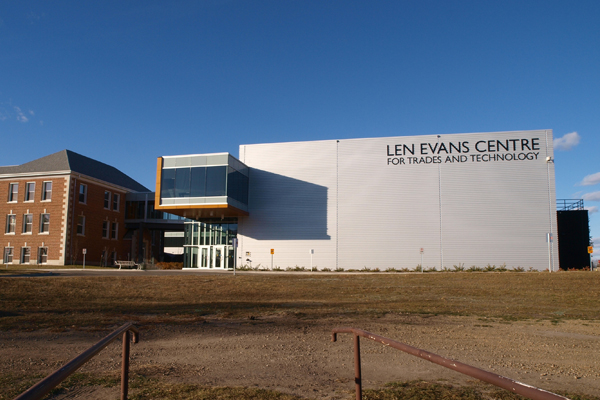
I’ve never attended Assiniboine Community College (ACC), but I have two brothers as well as many friends and colleagues who have attended or even taught there. ACC is a valuable piece of our educational puzzle here in Brandon and Westman. When I first saw the plan to move the college to the more spacious and by then unused Brandon Mental Health Centre (BMHC) grounds I thought it was a grand idea and a welcome expansion to our city.

As of 2014, the job is not completely done. The Brandon Sun reports in today’s edition that the main campus, currently at Victoria Avenue East and 17th Street East still needs to be relocated to the Parkland Building at the BMHC site on the North Hill. The move will take millions of dollars and a lot of construction work. For a more detailed rundown and the challenges of the move, the article by Lindsey Enns in the Sun is a good read.

ACC tries to stay on funding radar – Brandon Sun, April 26, 2014 (Paywalled)

One thing that I would urge the provincial government to consider is that when they are considering the move of ACC to its new home and the costs involved, they must also consider the costs involved in waiting too long to complete the project. Yes, there is the regular concern with actual costs going up with inflation that every project has to deal with, but I’m not talking about that. What I’m referring to is other needs of the citizens of Brandon that at first do not appear related to ACC.

My biggest concern is the fact that the Brandon School Division (BSD) has made it known to the province that the city will require another school in the south end in the next few years, presumably for early and middle years students. As a resident of the south end, the fact that some residents in this area end up in the Riverheights catchment area, a school that is in the far west end, shows that this need is most likely very real.

Another thing that I have noticed is that the vocational programs at Crocus Plains Regional Secondary School in the south end always seem to be bursting at the seams. I have had many people, parents and kids, tell me that the most popular programs are difficult to get into. We seem to have a couple of growing problems with education in this end of the city.

Believe it or not, the south end is over-served when it comes to high schools. Neelin and Crocus are essentially on top of each other. They are a 2.2 kilometre walk apart, I suspect that “as the crow flies” they are less than the 1.6 kilometres that the BSD and province use to determine bus eligibility. They are really close.

Neelin High School (Google Earth)It seems to me that the solution here would be to look at making Neelin something other than a high school. A short time ago, Earl Oxford was converted to a kindergarten to grade eight school; Neelin with its single story design seems even more suited to such a conversion. That partially solves the problem with the south end not having enough early and middle years capacity. But where does the population of Neelin then end up?

That’s where ACC comes in. If the move to the Parkland Building gets done, that opens up a building in the east end, a building that has hosted an educational institution for years, and a vocational program for years. The former ACC site could very well be home to a new, larger third high school for Brandon after any needed upgrades, and that location would serve the east end, and possibly the north end, better than Crocus and Neelin do now. A second high school in Brandon offering the vocational track seems to be something much needed in this growing city. I would personally be sad to see Neelin no longer be a high school, I graduated from there, but things change.

We need to make sure that we are spending our money in the right places. Yes, it is important to not spend money that we don’t have to, and I commend the government for not just throwing money at the ACC relocation without restraint. However, we need to make sure that that restraint will not cause us to have to build another school when our current infrastructure may do the job in a reconfigured way. Do we spend money on ACC that does not then have to be spent on public schools?

Sometimes spending money now may save you much more later. The question becomes, does this make sense?

I think it does.

Flip this house…

It is starting to get fairly evident that the next provincial election in Manitoba is not looking that great for the governing New Democratic Party. A number of recent polls have had the opposition Tories approaching the 50% mark in popularity, with the NDP hovering around half that, and the Liberals not far behind.

I fear it will only get worse for the NDP. In a province where politics is usually bland, where differences between the NDP and Progressive Conservatives seem minimal, it seems like the NDP have made enough people mad that voters will switch their vote to the other guy. The NDP seem sure to lose this next election. An unpopular rise in the provincial sales tax rate, a badly viewed decision on Bipole III, and former cabinet minister Christine Melnick being ejected from caucus all are making this look like a government becoming mired in controversy after over a decade in power. Many people see little difference between the two main parties, so switching your vote in Manitoba is often seen as fairly easy unless you are a die hard partisan. Hell, at one time both parties were led by a guy named Gary.

It’s looking bad for Premier Greg Selinger, and pretty awesome for Opposition Leader Brian Pallister. This is the part that frustrates me, there is a third party here, and if I had a feeling that more voters who would normally vote NDP would jump to the Liberals also, I would like to vote Liberal too.

The Liberals have a new leader with rural Manitoba roots, a unique perspective as a visible minority and a woman, and who is a graduate of law at the University of Manitoba. Rana Bokhari seems to me to be an interesting choice. I would like to see the Liberals have a chance in this election. During the last number of years, the Liberal’s former leader, Dr. Jon Gerrard, always seemed like the best choice each election, and often seemed like the most informed and thoughtful in the house. This party doesn’t seem to get enough of a chance in this two-horse province of Manitoba.

It seems like something other that our regular politics needs to happen right now, and until today I didn’t know what it was. As often happens, you need to bounce ideas of of someone until something sticks. Today was one of those days.

My brother and his wife were visiting on their way back home near Winnipeg when we started to discuss this very topic. We all agreed that something has to happen to make Manitobans see the Liberal party as a viable alternative to the NDP instead of trying out the Conservatives whenever we get tired of an NDP government; something needs to shift that momentum to the Liberals. We have a centre-left party (NDP), a centre-right party (PC), and a centre-centre party (Liberal). There needs to be a reason for Manitobans to see the Liberals as the progressive party in the next election.

Why?

Because most likely the NDP are going to be destroyed’’, is why. As someone who leans left, I know that the NDP are not forming the next government, and I will not be voting for the Tories. I would like my vote to count and I now lean toward Liberal.

So what needs to happen?

Some disenchanted NDP MLAs need to cross the floor, not to the Tories, but to the Liberals.

There are currently 37 members in the NDP caucus. I would not find it hard to believe that out of 37 members, that a few backbenchers would not find the current government’s trajectory in the polls worrisome, especially if they are personally quite liked. They may feel that they would be pulled down by the party brand in the next election. Jumping from the NDP to the Liberals in Manitoba would not be much of a philosophical jump either.

Brandon East is a good example where such a jump may help a candidate. The area has voted strong NDP for many years, but it seems that in the next election that the Tories may have a chance there. If the incumbent wants a better chance, maybe unhooking the dead weight of a faltering party might be a good first move. Caldwell has won the riding enough times that people are voting for him, not necessarily the party.

It gives the Liberals some much needed momentum, voters another progressive choice, and disenchanted NDP MLAs a life raft from a sinking ship.

Time to flip this house, and give some of these orange walls some red paint.

An enhanced misstep

I’m in the process of getting my passport. I don’t currently have travel plans, but the fact that I can’t even go to Bottineau right now without the right documents is annoying. I could have obtained a Manitoba Enhanced Driver’s License (EDL) for less money, but it’s inability to be used as a travel document for anything but land and water crossings, and the fact I lose it if I move out of province, makes it less than ideal.

2010-Enhanced-Drivers-Licence-female-front_HRAccording to the Winnipeg Sun, as of August 31, 2012 the Manitoba EDL program had issued 18,821 pieces of I.D. since the program started in 2009/2010. Apparently the program cost about $14-million.

Manitobans are not exactly running to sign up for this thing. As a comparison, in 2011 57.47% of Manitobans had passports according to Passport Canada. Assuming that the population of Manitoba is the 1,208,268 as stated in Wikipedia, then that would mean that 694,392 Manitobans currently have passports. That means that the rate of passports use in Manitoba is over 36 times as high as EDL use.

An EDL costs $30 over and above your driver’s licence, $50 for the non-driver version, and you renew normally every 5 years. A Canadian passport on the other hand is $120 for 5 years or $160 for 10 years. So in 10 years you would spend $60 on an EDL and $160 on a passport. The passport obviously costs more, but it is a document that allows you to do more in the long run. I’m not sure why we spent $14-million to save 18,821 people a hundred bucks each, we should have just cut them a cheque if we were being realistic.

This brings me to another point. If the Government of Manitoba wanted to make travel documents cheaper for Manitobans, they should have just looked at subsidizing passports. Now that we have the option for a 10-year passport, the province could subsidize the 10-year option by $30 bringing it down to $130, which is only $10 more that the five year. Convince the federal government to toss in a another $10 and 10-year passports for Manitobans would be the document of choice.

Assuming that 10% of passport holders would apply of renew each year, that works out to about 69,440 Manitobans per year getting a Canadian Passport. At a subsidy of $30 per person, the cost of the program would have been just over $2-million per year. That’s seven years of a program for the same cost that would have benefitted 36 times more citizens of the province.

The EDL program just wasn’t thought out.


As an aside, another thing I find annoying is how you go about the process of getting a photo for your passport. It seems ludicrous to me that I have to go get a private photo, have it certified by a guarantor, and then send it in. In 2014 when every province has photo driver’s licences, why do you not have them pull your latest provincial photo onto your passport. This seems like a simple cost-saving, cost-sharing solution between the levels of government.

Manitoba flag still sucks…

I dislike the Manitoba flag. I have for years. I first noticed how much I disliked it back around 2001. I was sitting in the parking lot at Superstore waiting for my spouse to pick something up when I looked at the flags flying there. We had just moved back from Saskatchewan that March and it struck me how much more the Saskatchewan flag stood out compared to the Manitoba one. Superstore there flew the Canadian and Saskatchewan flags, while here it is Canada and Manitoba.

I love the Canadian flag. Despite its relatively recent adoption in the late 60s, it is a wonderful symbol of our country. At once unique, simple in design, and unmistakeably Canadian. It is a wonderful flag. The Manitoba flag, not so much.

How do I know that it was 2001? Well, in June of that same year, the North American Vexillological Association (NAVA), a group dedicated to the study of flags, released a survey of their members on the flags of North American States and Provinces. We beat many states, but as far as Canadian flags go we were dead last.

Just looking at the thing, I knew it wasn’t a good design. It was kind of just intuitive. After NAVA’s survey I knew why. From their website at Nava.org:

The 5 Basic Principles of Flag Design

  1. Keep It Simple – The flag should be so simple that a child can draw it from memory…
  2. Use Meaningful Symbolism – The flag’s images, colors, or patterns should relate to what it symbolizes…
  3. Use 2–3 Basic Colors – Limit the number of colors on the flag to three, which contrast well and come from the standard color set…
  4. No Lettering or Seals – Never use writing of any kind or an organization’s seal…
  5. Be Distinctive or Be Related – Avoid duplicating other flags, but use similarities to show connections…

Using those basic principles it is easy to see why the Canadian flag is great flag design, and the Manitoba flag is not.

MbOnCRE

First, Manitoba’s flag (top) probably is fairly simple until you get to the coat of arms on the right hand side; then the thing gets overly complicated. It uses way too many colors , and worst of all, it is not distinctive. It is terribly difficult to tell apart from a number of other flags in Canada and the Commonwealth both historically and current.

It also not only duplicates the flags of Ontario (centre), and the Canadian Red Ensign (bottom), but all three actually contain the Union Jack from the United Kingdom in its entirety.

Worst of all, it is not distinctive. Fly any of those three flags to the left, and on a calm day you would not be able to tell them apart. That’s not even taking into account all the uses of the Red Ensign design outside of Canada. Sure, the flag does represent our history by using those symbols, but it ignores all the other peoples who have contributed to this province.

Because of its non-distinctive nature, the flag fails its most important role as a symbol. I look at the flag and it does nothing for me. It does not cause any feelings like those of the Canadian Maple Leaf flag. At least when I look at Saskatchewan’s flag, I see how it says “Saskatchewan.”

myflagSo, in 2001, after the news of NAVA’s flag rankings broke, I wrote to the Winnipeg Free Press and I suggested that they hold a contest for a new Manitoba flag. I included my idea for a Manitoba flag as seen to the right. I knew that the eventual winner would most likely not be adopted, but the Free Press ran with the idea anyway. My design was to keep it simple, at least simple enough to design in MS-Paint! The blue was to represent our northern lakes and expansive skies while the green represented our vast prairie landscape. The bison of course is a well used symbol of our province going back many years. It was also meant to have a similarity to the flag of our western neighbour Saskatchewan who we share much of our identity with.

My entry if I recall correctly made the top 10, which I was pretty happy with.

I do have to admit though, that I instantly fell in love with the winning entry, from Heather Jones of Winnipeg. I would be proud to fly it. It is distinctive, it is meant to represent Sunny Manitoba and the inclusion of the bison uses one of our most recognizable symbols. It has been suggested that the bison be reversed so that it is facing the flagpole as to not be considered rude, but other than that, it is perfect. I’d actually like to buy one to fly it.

« Older posts Newer posts »